
Returning to ShibataToku: A Different Kind of Craft Experience in Fukuoka

Not everything in travel is defined by what we experience. Some of it is what we leave behind.
When the last craftsman retired, the making of Hakata bentwood bento boxes at ShibataToku did not gradually fade—it came to a stop. The shop remained, but the ability to produce what it was known for disappeared with him.
For those who have followed this story, you will know that we have written about this moment before. What follows is not a continuation in the usual sense. It is a look at what has quietly unfolded since, and at something we did not expect to find. At the center of it, as always, is Yoshiko Shibata, the sixth-generation steward of the family business.


After the Making Ends, What Remains?
Late last year, during a visit to Shibata's small shop in Maidashi, our conversation turned to a familiar question: what, if anything, could still be shared with visitors.
Fukuoka has seen a steady rise in inbound travel, with most visitors moving predictably through well-known destinations such as Dazaifu Tenmangu. Meanwhile, Hakozaki Shrine , despite its long and significant history, remains relatively quiet. We asked Ms. Shibata whether she had ever considered offering a workshop of her own.
Her response was immediate. She felt she had nothing to teach. If she could not show people how to make the box itself, there was little of value to offer.
In her family, as in many traditional magemono workshops, the roles were clearly divided. The making of the box — bending the wood, shaping the form, handling the heavier technical work — was passed down through the men. The women worked alongside them in different ways: managing the shop, stitching the sakura bark bindings, painting the motifs that finished each piece. These were not secondary tasks, but they were not recognized as the "making."
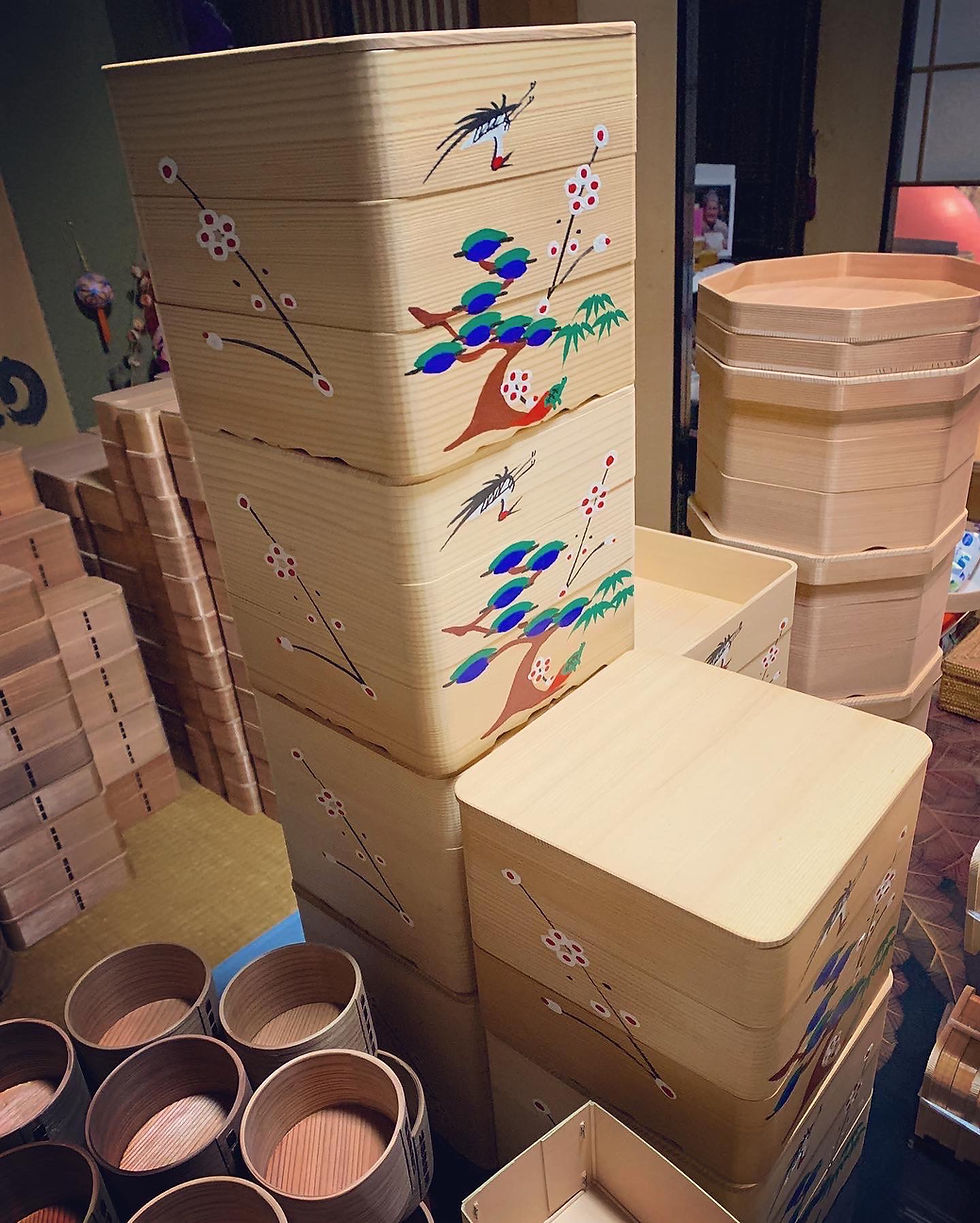
This is what Ms. Shibata learned — first from her grandmother, and later through years of working in the shop alongside her father.
She once told us: "I wish I had learned more from my father. Maybe then this wouldn't end with me." What she carries is not the making of the box. But it has always been part of it.
The Workshop She Never Planned to Run
Some time later, a government-run craft event reached out and asked if she would consider hosting a workshop. This time, Ms. Shibata said yes.
She took the idea entirely on her own terms: painting traditional motifs on wooden tops, a practice she had learned within her family over decades. She prepared the teaching materials, brought paint and brushes, and ran the sessions over two days. More than fifty people attended — many of them children.

When we visited about a month later, what stood out was not the scale of the event but her response to it. She spoke about the participants in detail: the excitement, the laughter from the families and children. Something had clearly shifted for her, even if nothing about the broader situation had changed.
Why a Craft Experience Doesn't Always Need a Hero Product
We spoke with a local tour guide about bringing international visitors to Hakozaki Shrine and to Shibata's shop, to learn about the history of Hakata magemono and spend time with the last person who carries this particular knowledge. The feedback we received was direct: without the ability to make the wood bento box itself, the activity would not be particularly appealing to tourists.
It is an honest response, and a common one. Much of what is valued in craft travel is tied to making the hero object. If it cannot be produced, the experience is often seen as incomplete.

But what gets overlooked in that assessment is everything that surrounds the making: the finishing, the inherited patterns, the gestures that have been repeated across generations. These rarely earn recognition on their own terms.
The question is not whether something is widely appealing. It is whether it is worth experiencing.
The Caruso Family Came Looking for Something Different
In March 2026, we encountered a family from Hawaii, the Carusos, who were visiting Japan with a specific intention. They were already familiar with the ShibataToku story and wanted their time in Fukuoka to mean something beyond sightseeing. They did not ask what they would make. They wanted to see Hakozaki Shrine, understand the history behind it, and spend real time with Ms. Shibata.
They sat together at a small table in the shop for about an hour. Ms. Shibata guided them closely, explaining the motifs as she had learned them, through repetition and memory, carried in her family across six generations. She adjusted small details as they worked, paying attention in a way that is difficult to replicate in a structured setting.
From the outside, it would have appeared simple.
What they valued was not what could be made, but what could be understood.
She Asked for the Photo
At the end of the visit, something unexpected happened.
Before they left, Ms. Shibata asked if they could take a group photo together.
In all the years we have worked with artisans in Japan, this had never happened before. Visitors often take photos, but it is rarely the artisan who initiates the moment.
For Yoshiko Shibata, it was a day she wanted to remember.

What This Kind of Visit Actually Is
Nothing about the broader situation has changed. The bentwood boxes are still no longer being made. No successor has emerged, and the conditions that led to that remain in place.
What has changed is more subtle. A part of the craft that had always existed, one that did not depend on producing the full object, has begun to surface in a different form. It is not a replacement, and it is not a revival. It is simply what remained, finding a way to continue.
Experiences like this do not fit neatly into what is typically promoted in Japan travel. They do not produce a clear outcome, and they are not designed to scale. But they reveal something that the more structured options rarely do: that a craft is not only what it makes.

If You Are Visiting Fukuoka
For those who have followed this story across the years, and for those encountering it now for the first time, there is another way to engage with it in person.
The ShibataToku magemono shop in Maidashi remains open. Even a short visit offers something that photographs cannot convey: the last works made in the shop, each bearing the heat-stamped brand mark of ShibataToku, and the chance to spend time with the person who has held this craft together.
If you find yourself in Fukuoka, we hope you will go.
What Remains

When a craft loses its ability to produce, it is often assumed to have ended.
But making is only one way a craft exists.
What remains may not be immediately visible or easily understood. It requires time, attention, and a willingness to engage without expecting a clear return.
Not everything that matters is widely recognized—and not everything widely recognized matters.


Comments